Limited Interoperability
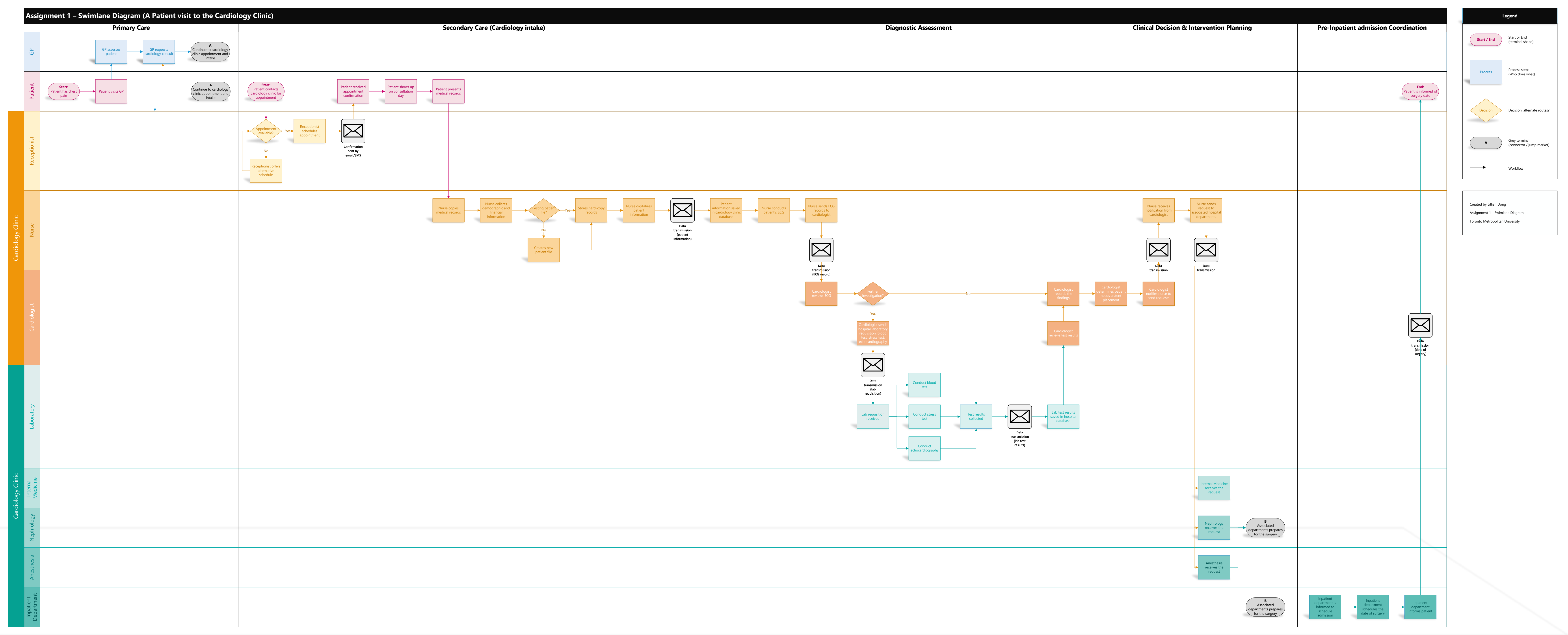
One challenge shown in the workflow is limited interoperability between care settings and information systems. When the patient does not already have an existing file, the nurse needs to create a new patient record rather than directly retrieving relevant information from another healthcare system. This may lead to repeated data collection, incomplete patient history, duplicated records, and delays in care coordination. From a health informatics perspective, stronger interoperability could allow patient information, referrals, and clinical history to move more smoothly across primary care, the cardiology clinic, and hospital systems.
Limited IT Workflow Integration
The workflow also suggests that several information exchanges are not fully integrated into the clinical process. After the cardiologist makes a decision, the nurse often becomes responsible for forwarding records, sending requests, or communicating the next step to other departments. These tasks are necessary, but they appear to rely heavily on manual routing. In a more integrated workflow, the decision maker could trigger electronic orders, referrals, or departmental notifications directly through the system, with automatic routing and status tracking. This could reduce unnecessary handoffs and make the care process more reliable.
Nursing Workload Concentration
The nurse lane contains a high concentration of tasks, including copying medical records, collecting demographic and financial information, creating or updating patient files, digitizing patient information, conducting ECGs, sending ECG records, receiving cardiologist notifications, and sending requests to associated departments. This suggests that nurses function not only as clinical caregivers, but also as documentation workers, information coordinators, and workflow routers. When too many administrative and coordination tasks are concentrated in one role, it may increase workload pressure and create bottlenecks in the care process.
Dual Record Maintenance
The workflow includes both digitized patient information and stored hard-copy records. Physical copies may serve as a safeguard or backup, especially when teams want to protect access to important patient information. However, maintaining both paper and digital records can create extra handling work, increase storage and retrieval effort, and raise questions about which version is the most current. As digital infrastructure becomes more reliable, this process could be optimized through secure digital backups, audit trails, access control, and disaster recovery planning, reducing the need for routine physical copies while still preserving safety and continuity.